- 1/1
Nils Hansteen, Sandøsund, 1882-1884. Foto: Grev Wedels Plass Auksjoner.
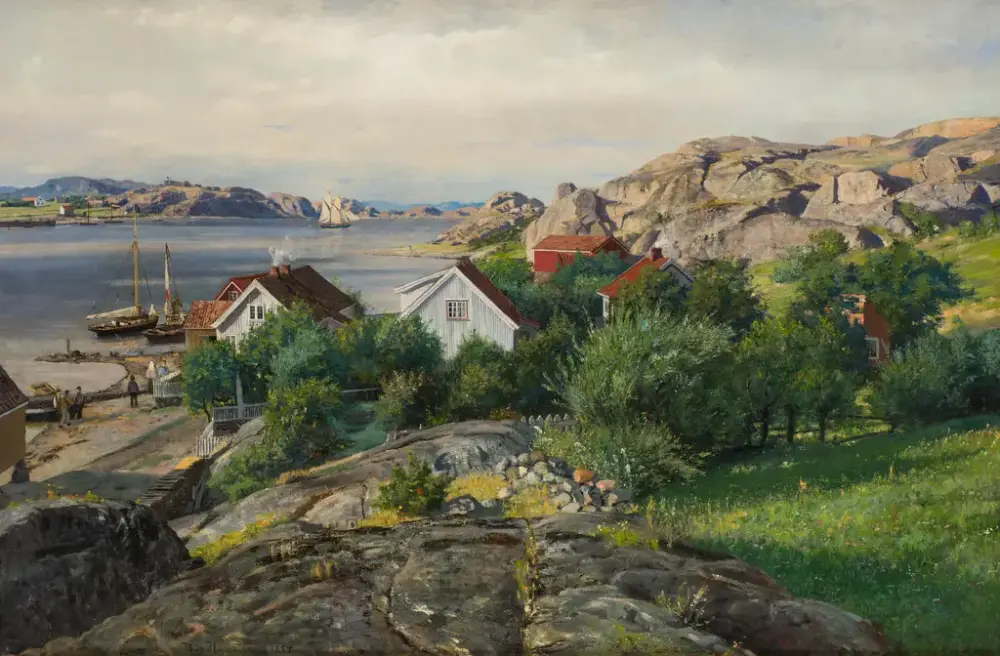
We pin a compass to the island of Hvasser and draw a circle around Brøtsø, Sandø and the southern tip of Tjøme. This small section of Vestfold's coastal islands has, despite its size, held great significance to generations of artists.
The modernists who visited the islands from 1880-1940 created an imagery and an understanding of art that still influences our view of how to be a modern person in a modern society. Our relationship to nature and landscape, to progress and tradition, and to body, gender and sexuality is deeply influenced by the modern ideology that was established around the turn of the last century.
The artists who visited the islands at the end of the 1800s used the landscape to express a national character, while railways and ferries provided modern city dwellers with increased access to the seaside for recreation and leisure activities. The area around Hvasser thus became an unexpected arena for the breakthrough of modernism in Norway, as paintings from the islands by Christian Krohg, Eilif Peterssen, Frits Thaulow and Nils Hansteen made up a significant part of the first Autumn Exhibition in 1882.
After the turn of the century, painted landscapes and portraits gradually adopt a heightened use of colour, light and surface, and the interplay of bodies engaging in outdoor activities become an important motif. A new body culture with an emphasis on physical activity, a healthy diet and a balanced mind emerges as a vital part of both the emerging popular culture and politics. For certain artistic communities, Tjøme, Hvasser and the surrounding islands became a sanctuary where they could explore their own values and ideals undisturbed.
Modernist architecture made its presence felt in the construction of cabins, with rational planning, open plan and views of nature. Cabin architecture is often informal and on a smaller scale, as the architects balance modernist style with the ideals of the holiday home.
This year's summer exhibition at Haugar Art Museum shows how Norwegian modernism in visual art and architecture was expressed in the period 1880-1940, seen within the framework of a narrow geographical demarcation. The project consists of both a book and an exhibition, and springs from a collaboration between Haugar Art Museum and the University of Oslo/IFIKK. The research project "Modernisms in Norwegian and Nordic Art and Architecture" is supported by Sparebankstiftelsen DNB and is led by Espen Johnsen, Bente Larsen and Øystein Sjåstad. Other contributors are Luisa Aubert, Øivind Storm Bjerke, Signe Endresen, Kirsten S. Faye, Kathrine Lund, MaryClaire Pappas, Øystein Ustvedt and Wenche Volle.
The exhibition Summer Light is based on this research and is produced by Haugar Art Museum with support from the Sparebankstiftelsen DNB and Anders Jahres Humanitære Stiftelse.